Gerald Brosseau Gardner stands at the threshold of modern Wicca like a figure half in history and half in legend. To many witches, he is remembered as the “Father of Modern Wicca,” not because he created every element of the Craft from nothing, but because he gathered, shaped, publicized, and transmitted the form of religious witchcraft that became the foundation of Gardnerian Wicca and, through it, much of modern Wicca as a whole. Recent scholarship continues to refine the picture of Gardner, especially Philip Heselton’s two-volume Witchfather: A Life of Gerald Gardner and John Callow’s 2025 Cambridge study Gerald Gardner and the Creation of Wicca, which describes Gardner as the central inspiration behind Wicca as a modern revived form of Pagan witchcraft.
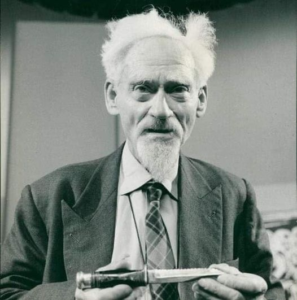
Gardner was born in 1884 and died in 1964, a lifespan that carried him through the late Victorian world, the British Empire, two world wars, and the postwar religious experimentation that made modern Paganism possible. He spent much of his working life in Asia, especially in colonial settings such as Ceylon and Malaya, where he encountered non-Christian religions, folk practices, ritual systems, and magical ideas outside the narrow frame of respectable English Christianity. Britannica notes that Gardner spent most of his career in Asia, became familiar with various indigenous religious traditions, and read widely in Western esoteric literature, including Aleister Crowley. This combination of travel, colonial experience, esoteric reading, amateur anthropology, ritual curiosity, and personal religious hunger shaped the man who would later present witchcraft not merely as folklore or superstition, but as a living religious path.
Gardner was not a systematic theologian in the academic sense. He was a collector, ritualist, storyteller, occult experimenter, and organizer. His importance lies in the fact that he stood at the meeting point of several streams: ceremonial magic, folk magic, Freemasonry, naturism, the Western occult revival, romantic ideas about ancient Pagan survival, and the writings of Margaret Murray, whose “witch-cult” theory is no longer accepted by mainstream historians but deeply influenced early Wiccan self-understanding. Gardner believed, or at least publicly claimed, that he had encountered surviving witches in England before the Second World War. His account of initiation into the New Forest coven remains one of the most debated episodes in Wiccan history. Modern scholars generally treat the claim with caution: some, like Heselton, have searched for historical people and groups behind Gardner’s story, while others emphasize Gardner’s creative role in synthesizing a new religious form from older occult and folkloric material.
The title “Father of Modern Wicca” is therefore best understood carefully. It does not mean Gardner invented every prayer, rite, symbol, or belief associated with Wicca. Nor does it mean that no witchcraft existed before him. Rather, Gardner’s achievement was the formation and public presentation of a coherent initiatory Pagan witchcraft religion at a moment when such a thing could finally emerge into public view. The repeal of Britain’s old Witchcraft Act in 1951 created a new social and legal opening, and Gardner took advantage of that opening with remarkable boldness. He appeared in media, associated himself with the Museum of Magic and Witchcraft on the Isle of Man, and became a public face for a religion that had previously been hidden, imaginary, persecuted, or dismissed as superstition.
Gardner’s two most important public books were Witchcraft Today, published in 1954, and The Meaning of Witchcraft, published in 1959. Witchcraft Today became one of the foundational texts of Wicca, presenting witchcraft as the remnant or revival of an old Pagan religion and introducing many readers to the idea that witches were not devil-worshippers but practitioners of a nature-centered spiritual tradition. The Meaning of Witchcraft followed in 1959 and was presented as a sympathetic account written from the standpoint of a practicing witch, helping further define witchcraft as a religious and magical path rather than merely a subject of folklore or fear.
Yet Gardner’s public writings only tell part of the story. His deeper influence came through coven work, initiation, and transmission. Gardnerian Wicca was not simply a set of ideas in a book; it was an initiatory tradition passed through ritual relationship. Gardner’s covens and priestesses became the living carriers of his Craft. Figures such as Doreen Valiente, Patricia Crowther, Eleanor Bone, Lois Bourne, and others helped refine, preserve, challenge, and spread what Gardner had begun. Valiente in particular played a crucial role in improving the poetic and liturgical quality of Gardnerian material, helping give Wicca some of its most enduring ritual language.
Gardner’s Wicca was built around several ideas that became central to modern Wiccan identity. It honored both Goddess and God. It treated nature, the body, sexuality, seasonal rhythm, and magical practice as sacred rather than sinful. It rejected the Christian demonization of witchcraft and reimagined the witch as priestess, priest, healer, celebrant, and magical worker. It placed the circle, the coven, initiation, polarity, the Sabbats, the Esbats, ritual tools, and the Book of Shadows at the heart of religious practice. Later Wiccans would revise, expand, soften, critique, or reinterpret many of these elements, but the Gardnerian pattern provided the basic grammar from which much of modern Wicca developed.
Modern scholarship increasingly recognizes Gardner as both a transmitter and an inventor. John Callow’s 2025 Cambridge study frames Gardner’s work as a new synthesis of magical beliefs drawn from Eastern and Western traditions, emphasizing that Gardner stripped away demonic interpretations of witchcraft and presented Wicca as a creative, mutable, undogmatic nature religion capable of personal empowerment. That description is especially useful because it avoids two extremes. On one side, it avoids the older claim that Gardner simply revealed an intact ancient religion unchanged from pre-Christian times. On the other side, it avoids dismissing Wicca as “fake” merely because it is modern. Religions are not made false by development, adaptation, or creative synthesis. All living traditions are woven from inheritance, experience, imagination, ritual, and community.
Gardner was also a complicated man. He was a product of his time, his class, his colonial experiences, and his own eccentricities. Some of his historical claims were weak. Some of his ideas have aged poorly. Some of his ritual material bears the marks of ceremonial magic, Freemasonry, romantic folklore, and early twentieth-century occultism as much as ancient Pagan survival. But this complexity does not diminish his importance. In fact, it makes him more historically interesting. Gardner was not a flawless prophet handing down a perfect revelation. He was a religious founder in the human sense: visionary, flawed, inventive, theatrical, courageous, controversial, and deeply consequential.
His genius was not that he preserved the past unchanged. His genius was that he gave the modern world a usable religious form through which people could again call themselves witches with pride. He helped transform “witch” from an accusation into an identity, from a figure of fear into a priestly and magical vocation. He gave modern Pagan witchcraft a structure strong enough to survive him and flexible enough to grow beyond him.
For HearthCraft Wicca and other later traditions, Gardner matters as an ancestor of the modern Craft. We do not need to accept every Gardnerian claim in a literalist way in order to honor his role. We can acknowledge that Wicca is a modern Pagan religion shaped by many streams while still recognizing that Gardner was the central public catalyst who brought it into history. Without Gardner, there may still have been modern Paganism, occult witchcraft, folk magic, and Goddess spirituality; but Wicca as we know it would almost certainly have looked very different.
Gerald Gardner died in 1964, but the religious current he helped kindle continued to spread through Britain, North America, Europe, Australia, and beyond. Gardnerian Wicca gave rise to related traditions, inspired new forms of witchcraft, and helped make possible the broader modern Pagan revival. Today, his legacy is best approached with both gratitude and discernment: gratitude for the door he opened, and discernment about the myths, claims, and historical uncertainties surrounding him.
To call Gardner the Father of Modern Wicca is not to make him the sole source of the Craft. It is to recognize him as the man who gathered the sparks, built the first modern hearth, and invited others to tend the flame.