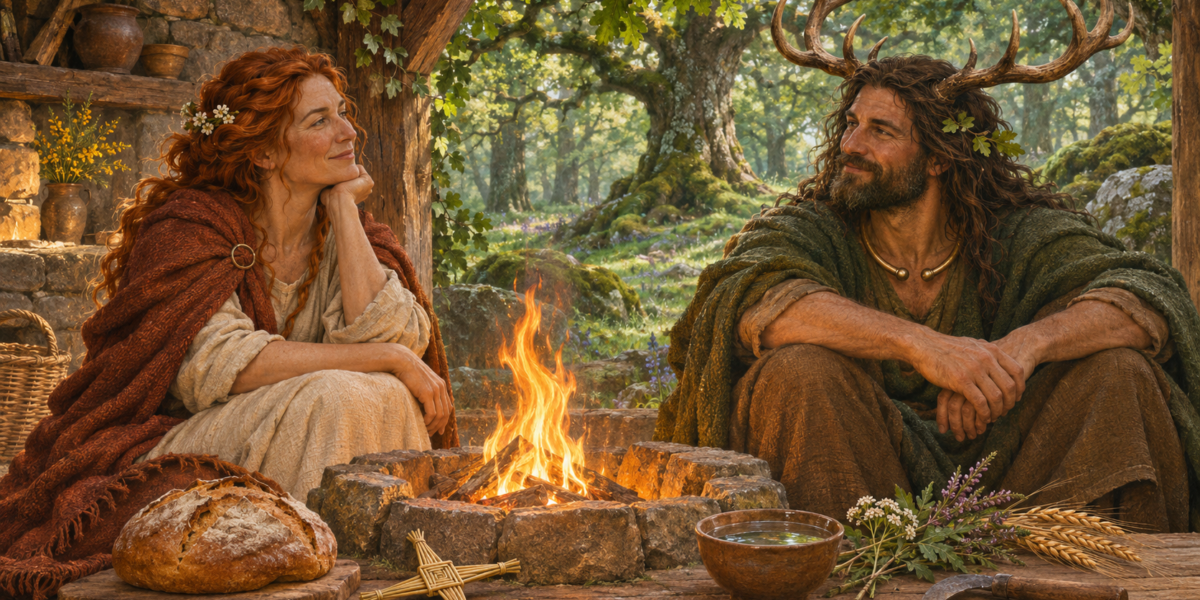
The hearth stands at the center of HearthCraft Wicca because it gathers together the relationships through which life is sustained. Food reaches the table through soil, weather, labor, and skill. A home becomes welcoming through the attention of those who live within it. Knowledge passes between generations through stories, shared work, and the patient teaching of ordinary things. To tend the hearth is to accept responsibility for these relationships and to recognize their sacred character.
In the Outer Court, we approach the Goddess primarily through Brigid and the Horned God primarily through Cernunnos. We honor Them as equal consorts, each worthy of worship and each offering a distinct relationship with the Sacred. Through Their devotion, we learn to bring inspiration, care, strength, and discernment into daily life.
This is a living Wiccan teaching informed by history, mythology, folklore, and present religious experience. Its roots reach into particular cultures, while its practice takes place in the homes and landscapes where we live now. Studying those roots helps us understand the gifts we have received and the responsibilities involved in carrying them forward.
Brigid and Her Inheritance
Brigid belongs first to the religious and literary inheritance of Ireland. Her name contains an element associated with height or exaltation, giving rise to the familiar interpretation “the Exalted One.” She is encountered as Brigit, Brighid, and Bríd, while Bride and Bridget are familiar forms in other contexts. The Manx feast name Laa’l Breeshey preserves another regional form. These names carry histories of language, devotion, and place.[1][2]
One of the clearest medieval witnesses to the goddess is Sanas Cormaic, or Cormac’s Glossary, traditionally associated with the period around the ninth and early tenth centuries. It describes Brigit as a daughter of the Dagda, honored by poets, and names two sisters also called Brigit, associated with healing and smithcraft.[2][3]
The grouping brings skilled knowledge into the religious sphere. Poetry gives experience a voice and a memorable form. Healing places knowledge in the service of vulnerable life. Smithcraft requires the ability to work with material, heat, timing, and effort. Read devotionally, these powers ask us to become capable of bringing something good into the world.
Brigid also appears where life cannot be repaired so easily. In Cath Maige Tuired, She is the mother of Rúadán, whose father is Bres. Acting for the Fomorians, Rúadán attacks the smith Goibniu and is fatally wounded in return. Brigid comes to lament Her son, and the narrative presents Her cries as the beginning of keening in Ireland.[4]
Her mythology therefore contains grief alongside creativity. The Goddess who inspires speech also gives suffering a voice. For HearthCraft, this makes room for devotion at the sickbed, during bereavement, and in the difficult work of accompanying someone whose pain we cannot remove. Care remains meaningful even when it cannot restore what has been lost.
Brigid’s name is related to that of Brigantia, attested in Roman Britain. A dedication from Birrens, in present-day Scotland, preserves Brigantia’s image with wings, a helmet, spear, and shield. The relationship between the names is significant, while the surviving local traditions deserve to be understood individually.[5] Brigid’s rich later devotional inheritance is especially associated with Ireland, Scotland, and the Isle of Man, and traveled farther through religious communities and migration.[2]
The Goddess and the Saint
Brigid’s history includes a Christian saint traditionally placed in the fifth and sixth centuries. The surviving Lives are later; Cogitosus wrote an influential Latin account in the seventh century. Some scholars understand the saint as a Christian transformation of a goddess’s cult. Others argue for a historical female founder whose memory gathered legendary material. The evidence permits debate, and a responsible account makes room for it.[2][6]
For pagan devotion, reclaiming Brigid begins with addressing Her as divine in Her own right. Where a goddess’s attributes passed into a saint’s cult, the religious terms changed: a Christian saint’s power operated through the Christian God. HearthCraft approaches Brigid as Goddess, with the reverence that relationship entails. Our worship does not depend on proving that the saint was wholly invented. We can also acknowledge the Christian families, storytellers, and religious women who carried Brigid’s name and customs across generations.
The flame at Kildare belongs to this layered inheritance. Around 1188, Gerald of Wales described nineteen nuns maintaining a fire in Brigid’s honor, with the twentieth night entrusted to Brigid Herself.[3] This is medieval testimony about a Christian community. Its relationship to a possible earlier cult remains a matter for investigation. The Brigidine Sisters rekindled a flame in Kildare in 1993, and a town-square flame was lit from it in 2006: documented acts of renewal with their own religious significance.[7]
Later household traditions make Brigid’s care tangible. Rush crosses protected homes and animal buildings. Cloth or ribbon left outside on the eve of the feast received Her blessing and was kept for protection and healing. Dressed images called brídeóga traveled between households, and wells associated with Her became places of pilgrimage. Dairying and cattle also occupy an important place in the inherited stories.[2][8]
Her feast on February 1 meets the seasonal threshold of Imbolc. The early evidence for the festival is much thinner than the detailed rites familiar today, and its precise relationship to the goddess requires care.[9] In HearthCraft, Imbolc gives us an occasion to renew devotion, bless the work ahead, and attend to returning possibility. We hold that imagery alongside the season actually unfolding in the land where we live.
Cernunnos and the Life Beyond the Door
Cernunnos approaches us through a different kind of evidence. The Gallo-Roman Pillar of the Boatmen in Paris preserves the antlered figure identified as Cernunnos, with neck rings suspended from His antlers. The monument places Gaulish and Roman divine figures alongside one another.[10] Ancient narrative evidence explaining His religious character is sparse, and scholars continue to debate interpretations of His imagery.[11]
HearthCraft’s devotion to Him develops within modern Wicca. We approach Cernunnos as the Horned God of the living land, animal kinship, embodied vitality, and strength brought into responsible relationship. These are the meanings through which our tradition learns to worship Him, informed by ancient imagery and present religious experience.
His place beside Brigid teaches the household to remember its dependence on the wider world. The water in the cup belongs to a watershed. The grain in the bread grew through weather and soil. Wood, wool, vegetables, and building materials reach us through other lives and human labor. The boundary of the home does not end our obligations.
Cernunnos therefore brings stewardship into daily devotion. To honor Him may mean learning the needs of local wildlife, tending the land within our care, reducing waste, sharing resources, or teaching a useful skill. Strength becomes religiously significant through what it protects and sustains.
Other traditions offer illuminating comparisons. Greek Pan is explicitly horned and pastoral in Homeric Hymn 19, associated with mountain country, flocks, and music.[12] Modern Heathen teaching concerning Freyr emphasizes good growing conditions and peace and plenty; His mythology also includes fighting with a stag’s antler.[13] Veles or Volos offers comparison through cattle and oath-taking, although broader reconstructions of His character remain contested.[14]
These parallels widen our understanding of religious life without erasing the identity of each figure. For HearthCraft, they sharpen the ethical meaning of prosperity: enough food, secure shelter, good relationships, and conditions in which other lives can flourish alongside our own.
Learning Across Traditions
Celtic, Germanic, Slavic, Greek, Latin, and Indo-Iranian traditions can be studied within an Indo-European comparative framework. Related languages, divine names, poetic expressions, and ritual structures sometimes preserve evidence of shared inheritance. Comparative scholarship also examines borrowing and the influence of neighboring cultures.[15]
The evidence has different degrees of strength. Similar responsibilities can develop wherever people depend on fire, food, livestock, and skilled labor. A household fire may become sacred through common human experience as well as inherited tradition. Recognizing that possibility allows us to learn from a parallel without claiming more than its sources establish.
HearthCraft also makes room for different religious understandings. Some practitioners encounter distinct gods and goddesses; others understand named deities as expressions of greater divine powers. Our shared devotion brings these experiences into a common practice. A theological understanding of divine unity is a matter of faith, while historical relationships between particular traditions require historical evidence.
The Sacred Fire in the Home
Hestia and Vesta offer close comparisons for our understanding of Brigid as Hearth Goddess. Homeric Hymn 29 gives Hestia a place at the beginning and end of a banquet’s offerings. It also invokes Hestia and Hermes together to dwell in the house in friendship.[16] Their cooperation shows one way divine relationship could express household wellbeing, although the hymn does not describe a marriage.
At Rome, Vesta’s sacred fire represented the continuity of the civic community, and the Vestals maintained Her cult.[17] The comparison with Kildare is meaningful as a study of sacred fire and its tending. Establishing a direct institutional descent would require a different body of evidence.
Lithuanian Gabija offers an especially intimate household parallel. Folklorist Daiva Vaitkevičienė discusses prayers addressed to Her when lighting the fire and covering its coals for the night. Some recorded prayers join Her name with Saint Agatha’s.[18] This Baltic tradition shows how a necessary daily action can carry a sustained religious relationship through changes in public religion.
Brigid’s hearth can be approached with comparable steadiness. A candle or lamp, a clean place to gather, and a short greeting repeated each day can become familiar means of welcoming Her. The attention matters more than an elaborate arrangement. A small room can hold a substantial religious life when the practices within it are sincere and sustainable.
To call Her Hearth Goddess also gives dignity to the labor that keeps people alive. Cooking, washing, making repairs, preparing bedding, and listening to someone who needs company deserve our attention. Their sacred character asks us to consider who performs them, whether the burden is shared fairly, and whether those giving care receive care themselves.
The Three Fires of Brigid
HearthCraft speaks of Brigid’s Three Fires as the hearth, the forge, and inspiration. This is our devotional arrangement, drawing on the medieval association with poetry, healing, and smithcraft. Healing runs through all three.
The fire of the hearth sustains life through repeated care. Its discipline is endurance: attending to needs that return, preparing another meal, keeping a promise after the first enthusiasm has passed. It teaches the student to make room for devotion within the work already entrusted to them.
The fire of the forge asks for competence. A craftsperson learns the material, practices, accepts correction, and takes responsibility for mistakes. Brigid’s forge gives us a religious language for that formation. We offer Her the effort of becoming more capable and the humility to recognize how much remains to be learned.
The fire of inspiration brings experience into expression. Poetry, music, study, teaching, and thoughtful conversation can each become places of encounter. Its discipline is to give an insight a worthy form. Inspiration acquires substance through the work needed to make it understandable, useful, or beautiful.
Together, the Three Fires join care to creativity and creativity to skill. An Outer Court student can begin with an ordinary commitment: learn something well, complete a useful task, or speak honestly about something that matters. Through such acts, worship gradually shapes conduct.
The Holiness of Work and Rest
The responsibility of the household appears in many traditions. Modern Heathen devotion approaches Frigg through protection and household care; Her concern for Baldr also offers a comparison with the parental love and grief found in Brigid’s mythology.[19]
Germanic and Alpine folklore gives another perspective through Holle and Perchta. Comparative research examines figures who oversee spinning and enforce periods when that work must stop, extending into other regional traditions, including Italian Befana.[20] The tales combine expectations of skill with boundaries around labor.
Slovak Lucia customs include restrictions on spinning and sewing, protective household practices, and visits by white-clad masked figures who sweep walls and corners.[21] Mokosh, also written Mokoš, deserves comparison through spinning and the care of sheep, while Her place in the Slavic pantheon remains incompletely understood.[22] Ukrainian scholarship documents related concerns around Paraskeva Piatnytsia, whose folk associations include household work, fertility, marriage, and the dead.[23]
These traditions have their own settings and histories. For HearthCraft, they invite a practical teaching: dedicated work and protected rest belong together. Putting tools down can be a religious act when it allows the worker to recover, the household to gather, or a festival to receive full attention.
Our practice can express that insight through a weekly shared meal, an evening free from unnecessary chores, or a deliberate pause after completing a demanding task. Labor should be distributed with consideration for ability, time, and need. The sacredness of care gives us reason to support the caregiver and to recognize that exhaustion is a household concern.
Seasonal Objects and Ancestral Memory
Handmade seasonal objects allow a household to give visible form to time and memory. The actions performed with them help explain their meaning.
Brigid’s later traditions include welcoming Her image and blessing the household. In Slovak custom, Morena’s effigy is carried away and destroyed in rites intended to bring spring. The custom is documented, while its reconstruction as the cult of an ancient goddess remains a subject of inquiry.[24] A welcoming image and an expelled effigy can share materials while performing different religious work.
The Ukrainian didukh gives another example. The decorated grain sheaf represents harvest, prosperity, and deceased family members and is brought into the home during the Christmas season.[25] It connects the food sustaining a household with the generations who sustained it before.
Italian Befana’s gift-bearing visit at Epiphany offers another form of seasonal encounter at home.[26] The family prepares, the visitor arrives, and the calendar becomes an experience children and adults can remember. Such customs deserve attention in their own cultural settings, including the Christian settings in which many have been preserved and developed.
HearthCraft households can learn from this attention to material things. A rush cross, a harvest ornament, an inherited spoon, a photograph, or a family recipe can carry a story. Making an object together, explaining its meaning, and renewing it in its season allows teaching to pass through the hands as well as through words. Families may also continue inherited Ukrainian, Slovak, Italian, or other customs under their own names.
Ancestor and household-spirit devotion gives this memory an ongoing place. Roman religion honored protective presences such as the Lares, whose origins remain debated.[27] Modern Heathen hearth practice maintains relationships with gods, ancestors, and wights through repeated ritual and offerings.[28] HearthCraft likewise recognizes relationships with the honored dead and the spirits of home and place. We attend to those relationships through gratitude, remembrance, and the care of what has been entrusted to us.
Brigid and the Threefold Goddess
Threefold imagery has genuine historical examples. Cormac’s Glossary names three Brigits associated with different skilled activities. Romano-British material also includes groups of Mother Goddesses; one dedication preserves three enthroned Mothers honored by a worshipper recalling his homeland overseas.[3][29] These patterns establish religious plurality in groups of three, with meanings that must be understood from their particular evidence.
In HearthCraft, Maiden, Mother, and Crone or Elder form a Wiccan pattern of beginning, sustaining, and wisdom. We approach Brigid through all three as a devotional interpretation, rather than assigning those ages to the three medieval Brigits.
As Maiden, She meets us in the courage to begin and the freedom to learn. As Mother, She is present in creating, sustaining, and protecting life, including the love that continues through bereavement. As Elder, we approach Her through practiced judgment, memory, and the understanding that has passed through loss.
These currents describe spiritual capacities available throughout a person’s life. They give room to people who never become biological parents and to those whose lives unfold outside an expected sequence. A beginning can arrive in old age, and wisdom can appear in youth.
Our teaching also makes room for the God as Youth, Steward, and Elder: courage, responsibility, and mature discernment. These are HearthCraft ways of approaching divine fullness. Through both deities, students can learn when to act, how to sustain a commitment, and when to release it.
Brigid and Cernunnos as Equal Consorts
The Outer Court’s pairing of Brigid and Cernunnos belongs to HearthCraft’s living Wiccan theology. It gives our shared worship two named divine presences through whom we approach Goddess and God. We distinguish that partnership from the surviving Irish stories about Brigid and Bres.
Consort expresses a reciprocal relationship. Brigid is Cernunnos’s consort, and Cernunnos is Hers. Each receives worship in their own right. Their partnership teaches mutual regard and the creative possibilities of relationship between distinct powers.
Honoring the Goddess can have a restorative meaning for people whose earlier religion spoke of ultimate divinity primarily in masculine terms. HearthCraft recognizes that experience while affirming the God’s full sacred worth. Balance also has roots in modern Wicca: in a 1991 interview, Doreen Valiente recalled the presence of both deities in the Craft she entered in the 1950s and explicitly advocated reverence for both.[30]
That equality must be visible in our practice. Students give Cernunnos His own prayers, study, offerings, and devotional attention, just as they develop a relationship with Brigid. Seasonal rites and individual callings may emphasize one presence while keeping both fully within our religious life.
Their gifts also extend beyond narrow divisions of household roles. Brigid has the forge and the power of inspired speech. Cernunnos can nurture, shelter, and teach patience. We may encounter Her beyond the threshold and Him beside the hearth. Care, courage, provision, and wisdom belong within the lives of all who worship Them.
Keeping the Hearth in Daily Life
Outer Court practice begins with something small enough to repeat. Choose a place that can receive a few moments of attention each day. Set a candle or lamp there, perhaps with clean water and an object representing the season. Greet Brigid and Cernunnos by name. Offer thanks for something received and name one responsibility you intend to meet.
Let the day’s work answer that greeting. Dedicate a task to Brigid’s fire: practice a skill, prepare food, mend an object, or make time to listen. Offer Cernunnos an act of stewardship: share a resource, care for the land within reach, or help someone become more capable. Over time, allow these acts to draw on the fullness of both relationships.
At the day’s close, return briefly to the shrine. Consider what received your attention and what still needs care. Remember someone who has helped sustain your life. Thank the deities and extinguish the candle if you have used one. Let the household rest.
On a weekly or seasonal occasion, gather around a shared meal or a simple act of making. Tell the story of an ancestor, learn where an ingredient came from, renew a household blessing, or teach a child something useful. Give the turning year a form the household can recognize and carry forward.
For a seeker, these practices establish the foundations of religious life before more demanding work is undertaken. They cultivate attention, gratitude, competence, and responsibility. The evidence of devotion gradually appears in the home itself: in the way its people speak, share labor, welcome others, and care for the lives around them.
An original HearthCraft blessing may be offered:
Brigid and Cernunnos,
be welcome at our hearth.
Lady of inspiration and sacred craft,
bless the work entrusted to our hands.
Horned One of the living land,
guide our strength toward the care of life.
Teach us to give with gratitude,
to receive with discernment,
to honor our dead,
and to make room for rest.
May our home offer shelter,
and our devotion bear fruit in the world.
Sources and Further Reading
- Edel Bhreathnach, St Brigit Who Was She, History Ireland; and A. W. Moore, The Folk Lore of the Isle of Man Chapter VI, 1891.
- Noel Kissane, Brigit Brighid Bríd Bride Bridget, Dictionary of Irish Biography.
- Elva Johnston, St Brigit of Kildare Patron of the Powerless, UCD Library Cultural Heritage Collections, 2018. Discusses Sanas Cormaic and Gerald of Wales’s account of the fire.
- Cath Maige Tuired The Second Battle of Mag Tuired, translated by Elizabeth A. Gray, especially sections 125–127, CELT edition, University College Cork.
- Brigit Saint or Goddess, University College Cork; and RIB 2091 Dedication to Brigantia.
- Niamh Wycherley, Will the Real St Brigid Please Stand Up, Maynooth University. Presents the case for a historical founder at Kildare.
- Brigid’s Fire, Brigidine Sisters. Account of the modern rekindling.
- Clodagh Doyle, St Brigid’s Day a Weaving Tradition of Celtic Rituals Christian Faith and Enduring Folk Customs, National Museum of Ireland.
- Tatyana Mikhailova, February 1st in Ireland Imbolc and or Lá Fhéile Bride From Christian Saint to Pagan Goddess, The Yearbook of Balkan and Baltic Studies, DOI 10.7592/YBBS3.05.
- Le Pilier des Nautes, French Ministry of Culture, Paris antique.
- Alexandre Léonet, Cernunnos Approche historiographique d’une figure emblématique gauloise, Ausonius Éditions. French text.
- Homeric Hymn 19 to Pan, translated by H. G. Evelyn-White.
- Freyr Yngve, The Troth. Contemporary Heathen treatment with discussion of older sources.
- Milorad Ivanković, New Insights on Slavic God Volos Veles from a Vedic Perspective, Studia mythologica Slavica 22, 2019, pp. 55–81.
- M. L. West, Indo European Poetry and Myth, Oxford University Press, 2007. Further reading on comparative method and inherited religious and poetic patterns.
- Homeric Hymn 29 to Hestia, translated by H. G. Evelyn-White.
- Temple of Vesta and Vestal House, Parco archeologico del Colosseo.
- Daiva Vaitkevičienė, Verbal Charm vs Prayer An Emic Approach to the Lithuanian Terminology, Incantatio 12, 2024, pp. 32–62, especially pp. 40–41.
- Frigg, The Troth.
- Mirjam Mencej, Mythical Beings Punishing the Breaking of Taboos on Spinning.
- Viera Feglová, Lucia, Centre for Traditional Folk Culture, Slovakia. Slovak text.
- Tatiana Cibulová, Mokoš, Centre for Traditional Folk Culture, Slovakia. Slovak text.
- Halyna Koval, Christian Feminine Images in Ukrainian Folklore. Ukrainian text with English summary.
- Eleonóra Klepáčová, Morena, Centre for Traditional Folk Culture, Slovakia; and Stanislav Gubančok, Was Morena Really an Ancient Slavic Goddess, CEREHIS, 2023.
- Olena Pantelei, The Story of One Exhibit The Didukh, Kharkiv Historical Museum, 2021. Ukrainian text.
- Epiphany in Italy Befana Meaning and Traditions, Italia.it. Contemporary feast and household customs.
- C. Robert Phillips, Lares, Oxford Research Encyclopedia of Classics.
- Hearth Cult Guide, The Longship. Contemporary Heathen practice.
- RIB 1318 Dedication to the Three Mother Goddesses, Roman Inscriptions of Britain.
- Michael Thorn, FireHeart Interview Doreen Valiente Part Two, interview conducted in 1991 and republished in 2019.
HearthCraft’s devotional interpretation draws on the tradition’s public introduction and its Outer Court teachings. The blessing above is newly composed for this article.